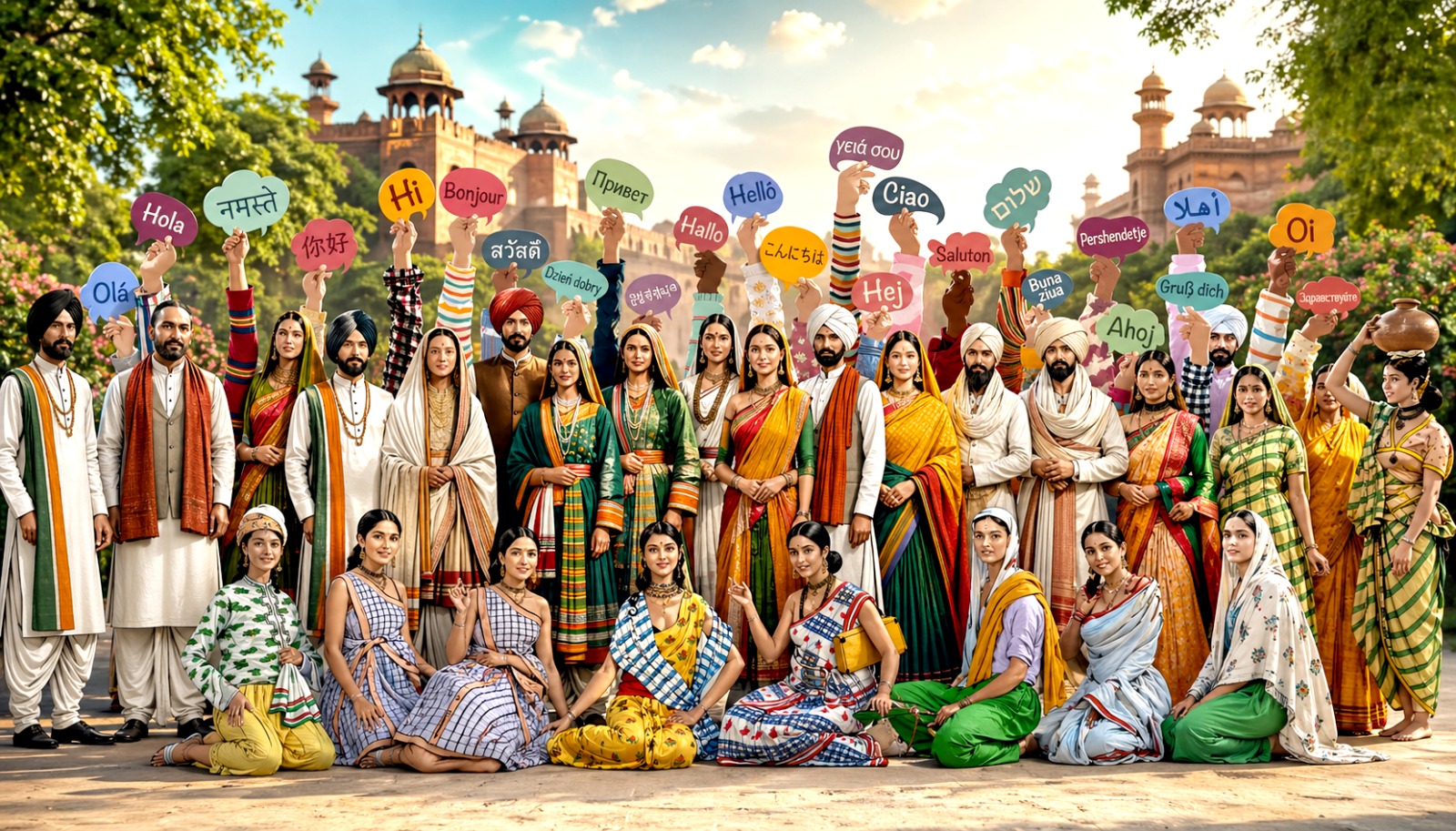
A language that is well-established is said to have three important aspects by linguistic experts:
➤ i) Sub-Dialect – This is a highly localized form of the spoken language that may have a small area or district over which it is used. Especially in earlier times before the advent of technology and mass communication, local dialects could be clearly seen.

➤ ii) Dialects – These have a wider geographical presence than sub-dialects and may even show literary activity. There is some distinction of vocabulary and grammatical structure and over time, some dialects attain the status of language proper.
➤ iii) Standard language – Has true recognition of a mature language with distinct vocabulary, grammar and literature; in India considered national languages, used in mass communication such as media and for higher education.
✦ Over time, the sounds, that is, the pronunciation of many words in any language keep changing. We see many changes in the way English words are used across the centuries, and also between Vedic and classical Sanskrit. These phonetic changes are due to mainly five reasons –
➤ i) Economy of effort – Everybody prefers to pronounce words more easily, with less effort.
As illustration we can consider the following:
सत्य ➝ सच, प्रचार ➝ परचार, चक्र ➝ चक्कर etc.
➤ ii) Shortening of long words – This is especially noticeable in names or proper nouns. During the British colonial times, Anglicized names for persons and places came into use.
E.g. Mukherjee for Mukhopadhyaya, Deccan for Dakshin, Upadhya became Ojha which became Jha. Kolkata became Calcutta.
➤ iii) Improper or incomplete repetition – Often words are not carried forward in intact form, but rather with some changes as per local pronunciation.
E.g., ‘Lakshmi’ ➝ ‘Lokkhi’ (Bihar & Bengal), ‘Lechumi’ (Tamil Nadu)
‘Lakshman’ ➝ ‘Lakhan’, ‘Sita’ ➝ ‘Siya’
‘Om namaḥsiddham’ ➝ ‘Onāmāsīdham’
‘Visham’ (poison) ➝ ‘Bis’ (Bihar-Bengal), ‘Vidam’ (Tamil)
ओम्नमःसिद्धम् ➝ ओनामासीधम्
➤ iv) Lack of education – When uneducated people repeat words according to their own usage, phonetic changes may become transmitted and over time, these forms gain currency and become part of the language.
E.g., गङ्गोपाध्याय ➝ गङ्गुली, प्रभात ➝ परभात, गोस्वामी ➝ गोसैन्, सूर्य ➝ सूर्जो / सूरज
➤ v) Poetic usage – In order to maintain metrical tempo (Chandas), words are often slightly altered while retaining resemblance.
E.g., नदी ➝ नदिया, द्वार ➝ दुआर, नहीं ➝ नाहीं, वीर ➝ वीरा
✦ The phonetic changes may be of types such as Aspiration, De-aspiration, Vocalization, Nasalization, shortening of long sounds and lengthening of short sounds:
गृह ➝ घर, शाक ➝ साग, काक ➝ काग, सर्प ➝ सांप, अक्षि ➝ आंख, अश्रु ➝ आंसु, वानर ➝ बन्दर, अद्य ➝ आज, प्रियतम ➝ पीतम
✦ With this background, we can understand transformations of words from early literature such as Vedas and Puranas to classical Sanskrit. In Panini’s grammar, Vedic Sanskrit is referred to as “Chandas” and the spoken language as “Bhasha.” Panini recorded many changes and regional variations. Once his grammar became established, Sanskrit acquired a polished, standard form understood across millennia, making it a lingua franca.
✦ ❖ Did Sanskrit come from Prakrit or vice versa?


➤ Since ‘Prakrit’ means “natural” or “raw” and ‘Samskrit’ means “polished” or “refined,” some scholars believe Sanskrit evolved from Prakrit—like a rough mineral refined into a gem.
➤ Others argue the opposite—that Prakrit forms are derived from Sanskrit structure.
➤ A third view suggests both coexisted as parallel modes of expression in society.
✦ ❖ Conclusion based on linguistic behavior
When we study how languages naturally evolve, it appears that:
➤ Sanskrit functioned as the structured, grammatically governed, formal language.
➤ Prakrit emerged as the natural, colloquial, simplified spoken form used by common people.
➤ Linguistic change typically moves toward simplification, not complexity.
✦ Therefore, it is more natural to conclude:
➤ Sanskrit preceded Prakrit, and Prakrit developed from it through gradual phonetic simplification and regional variation.
✦ In essence:
➤ Prakrit = natural, colloquial, simplified expression
➤ Sanskrit = refined, grammatical, formal expression
✦ The human tendency toward ease and economy of effort strongly supports the evolution of Prakrit from Sanskrit rather than the reverse.
✦✦✦
✦ Team Siddhanta Knowledge Foundation ✦
✉ Siksha.siddhanta@gmail.com
🌐 https://siddhantaknowledge.org/












 https://www.youtube.com/watch?si=RtToJsBhYBatUrym&v=mOuYNSdhjHA&feature=youtu.be